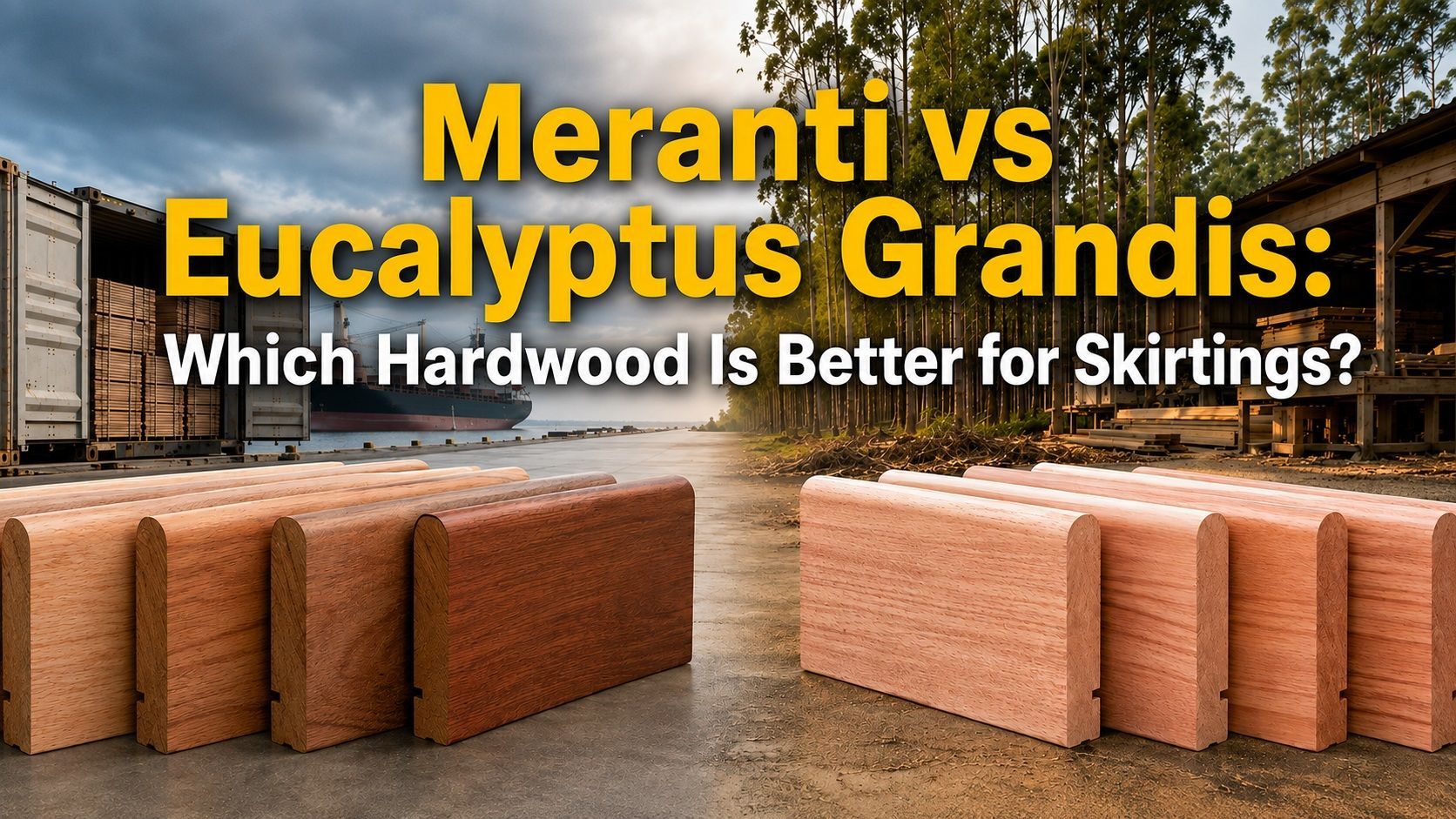
We do supply Meranti on request and availability.
Meranti has been sold in South Africa for many years as a familiar hardwood for skirtings, mouldings, doors and other joinery. Because the name is so well known, many buyers assume that Meranti is one specific timber with a predictable colour, density and quality.
That is not the full story.
"Meranti" is a commercial trade name covering a broad group of related Southeast Asian hardwoods, mainly from the Shorea genus. Regional names such as seraya are also used for some of these timbers. This means that Meranti should not be understood as one single, uniform species.
For the South African customer, the name can therefore be misleading. It creates the expectation that every board in an order should look and behave much the same. In practice, the imported Meranti available to us has varied noticeably in colour, density and machining performance - even within the same purchase.
This article is not based only on theory. It reflects Visto Mouldings' direct experience of buying Meranti in bulk from South African importers, machining it in our factory and dealing with the concerns raised by our customers.
We Cannot Cherry-pick the Best Meranti
When Visto Mouldings buys Meranti from an importer, we have to buy complete bundles. We cannot open every pack, select only the most attractive boards and leave the rest behind. Like other manufacturers, we must work with the quality and mix contained in the bundles available.
We have bought multiple bundles at the same time, expecting that one bundle might be better than another. Our repeated experience has been that the bundles offered to us are broadly the same mainstream quality. Choosing a different bundle does not solve the underlying problems.
South African importers have told us that the grade commonly bought for this market is Standard and Better. It is important to explain what this means fairly. Standard is not the lowest recognised grade. Under the Malaysian grading system, Prime and Select sit above Standard, while Sound, Serviceable and Utility sit below it. "Standard and Better" therefore means that Standard is the minimum grade in the parcel and that some pieces may be better.
However, it is still several steps away from the premium end of the grading scale. Buyers in other markets can specify and pay for higher Prime or Select grades. In our experience, those are not the grades routinely offered to us by local importers.
We are not claiming that every Meranti shipment entering South Africa is identical. We are saying that Standard and Better is the mainstream imported Meranti repeatedly made available to Visto Mouldings - and it has not delivered the consistency we want for our customers.
The Problems Appear When the Timber Is Machined
A rough board can look acceptable in a strapped bundle. The true quality often becomes clear only once the timber passes through the moulding machines.
With the Meranti available to us, we have experienced frequent chipping and chip-out during machining. Grain direction, density and working characteristics can change from one board to the next. A profile that machines cleanly on one piece may tear or chip on another.
This creates high waste. Some boards or sections have to be rejected, cut back or reworked, which adds labour and reduces the amount of saleable product recovered from a bundle. Permitted pinholes and other natural or grade-related characteristics can reduce the usable yield even further, depending on the final application and the finish the customer expects.
The manufacturer carries that waste, but the end customer also feels the effect through inconsistent appearance, availability and price.
Colour Variation Is One of the Biggest Customer Complaints
Natural timber will always show some variation, and that is part of its beauty. The problem arises when the difference becomes too large within a single order.
The Meranti supplied to us can range from pale pink or light brown to a much darker reddish-brown. When these boards are installed together as skirtings, mouldings or cladding, the contrast can be very noticeable.
We have received many customer complaints about large colour differences within an order. The customer sees one product name - Meranti - and reasonably expects the pieces to coordinate. Explaining afterwards that Meranti is a mixed commercial grouping does not change how the completed room looks.
For Visto Mouldings, this became an ongoing quality-control problem. We could spend more time sorting the boards, but because we buy sealed or strapped commercial bundles rather than hand-selected premium stock, sorting cannot create consistency that is not present in the original parcel. It simply creates more rejected timber and more waste.
Why Visto Moved to Clear and Semi-clear Eucalyptus grandis
These repeated issues are why Visto Mouldings decided to move away from the imported Meranti available to us and focus on clear and semi-clear Eucalyptus grandis.
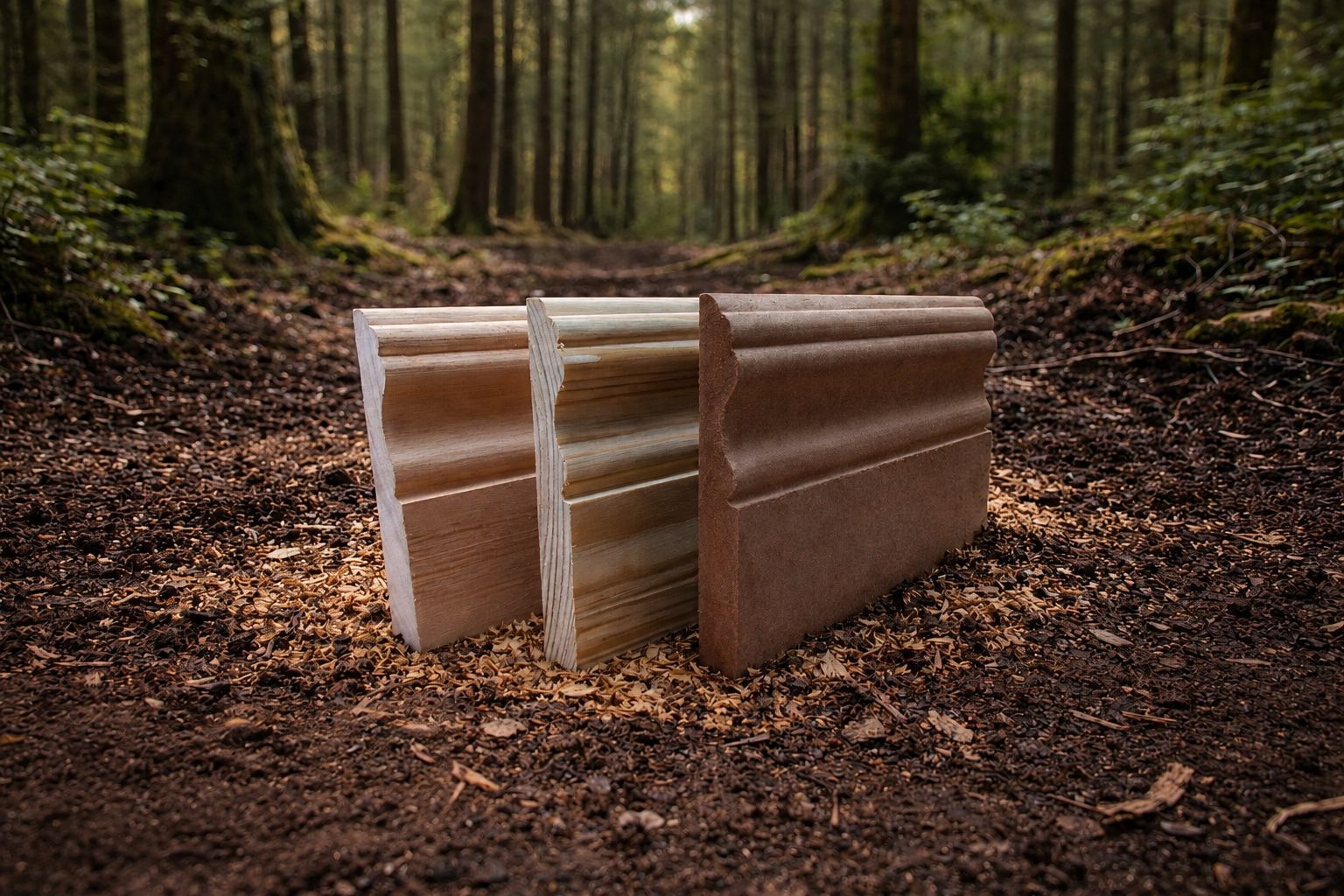
Eucalyptus grandis is grown locally in South Africa. At Visto Mouldings, we select clear and semi-clear material for our hardwood skirtings, mouldings, cladding and decking. This higher material selection gives us a more reliable starting point before a board reaches the machine.
In our factory experience, our selected Grandis is consistently firm and machines far more cleanly across an order. We achieve smoother profiles with considerably less chipping, which means better recovery, lower waste and a more dependable finished product.
Grandis does still have natural colour variation, as every real timber does, but it generally remains within a more coordinated pink to reddish-pink family. It also has an attractive grain that can resemble Meranti. When a traditional brown appearance is required, Grandis accepts stain well and can be finished to achieve a Meranti-like look without relying on the inconsistent Meranti stock available to us.
Our Customers Have Noticed the Difference
The most important test is not what we say about our timber - it is what customers say when they receive it.
Since changing to clear and semi-clear Eucalyptus grandis, we have been praised countless times for the quality of orders collected from our factory and delivered to customers. Clients notice the cleaner machining, the better material selection and the more coordinated appearance across an order.
That feedback confirms why we made the change. We are no longer trying to make an inconsistent imported bundle perform like a premium product. We are starting with a locally grown timber selected to meet the quality level we want to put our name behind.
More Stable Pricing Through the Year
Price is another important difference for South African buyers.
Meranti is imported, so its selling price can be affected by exchange-rate movements, international supply, shipping costs, importer stock levels and purchasing cycles. We have seen Meranti remain expensive for long periods, only for the price to drop suddenly and move into the same range as our hardwood Grandis skirtings or decking.
This makes Meranti difficult to budget for. A customer may compare prices in one month and reach a completely different conclusion a few months later.
Our Eucalyptus grandis pricing has remained far more stable through the year because the timber is locally grown and is not exposed to the same import and Rand-Dollar pressures. No timber price can be guaranteed never to change, but Grandis gives us a much more predictable basis for quoting, production planning and customer budgeting.
The cheapest price on a particular day is also not the full cost of the product. Colour sorting, chipped profiles, rejected sections, rework and installation concerns all have a cost. A more consistent board that machines cleanly can offer better overall value, even when two advertised prices look similar.
Supporting South African Industry
Grandis also gives customers an opportunity to support the South African timber industry. The trees are grown locally and the timber is processed locally into finished products such as skirtings, mouldings, cladding and decking. This supports South African growers, transporters, timber processors, manufacturers and jobs.
Meranti, by comparison, reaches us through a long international import chain and is exposed to shipping costs, exchange-rate movements and importer stock cycles. Choosing Visto's clear and semi-clear Eucalyptus grandis is therefore not only about cleaner machining, better consistency and more stable pricing - it also supports a stronger local timber value chain.
So, Which Timber Is Better for Skirtings?
High-grade, carefully specified Meranti can be a good joinery timber. Our objection is not to every board carrying the Meranti name. Our objection is to the inconsistent Standard and Better material that has repeatedly been available to us through South African importers - and to the assumption that the word "Meranti" guarantees one species, one colour or one level of quality.
For Visto Mouldings, clear and semi-clear Eucalyptus grandis is the superior choice for hardwood skirtings, mouldings, cladding and decking. It gives us:
• a higher and more controlled material selection
• cleaner, more predictable machining
• substantially less waste from chipping
• a more coordinated pink-toned appearance
• the option of staining it to a traditional brown Meranti-like finish
• locally grown timber with more stable pricing;
• a finished product that continues to earn praise from our customers.
We believe customers deserve to know what they are buying. A familiar trade name is not the same as a consistent grade. For us, the quality of the actual boards - and the finished mouldings they produce - matters more than the name attached to the bundle